
Who am I?
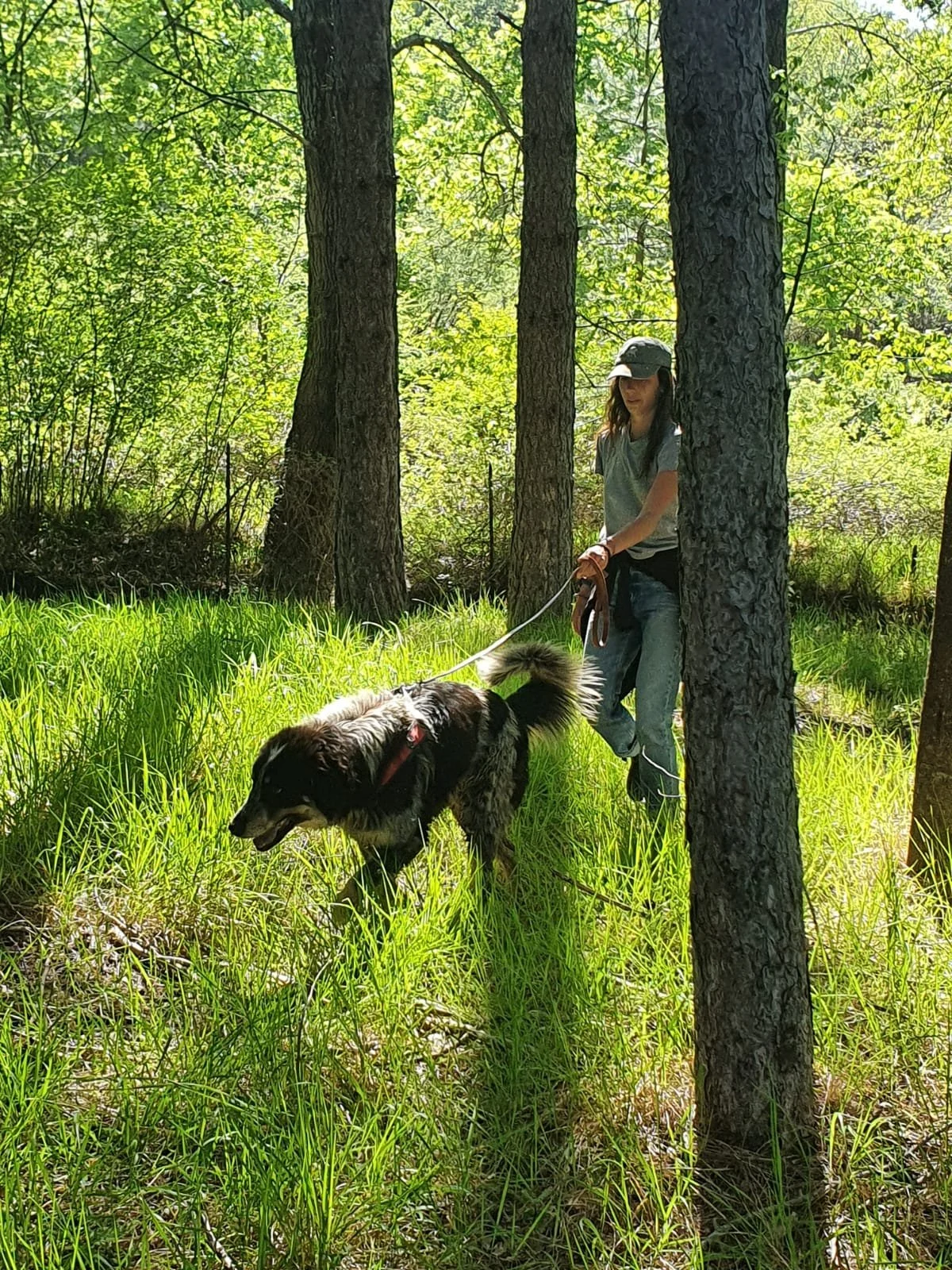
My name is Valentina Baduini; I’m 35 years old and I live between Palau and Sassari, in Sardinia. I’m a Natural Sciences student at the University of Sassari, and I like to call myself a “Canine Researcher.” I combine my university studies with the observation of dogs, striving to develop an approach to working with dogs that brings together knowledge, observation, and respect for their nature.
Academic and Professional Education
NATURAL SCIENCES – University of Sassari (UNISS)
September 2024 – Currently enrolling
A specialization program dedicated to the study of ecosystems, biodiversity, and the biological dynamics that govern the environment.WILDLIFE ASSISTANT – City of Sassari
March 2026 – August 2026
Operational activities to support the management and monitoring of wildlife within the municipal area.ENCI Dog Trainer, Section 3 (Hunting Dogs)
October 2025 – April 2026
Technical specialization focused on breeds selected for hunting, exploring their natural abilities and motivations in rural settings.COGNITIVE-BEHAVIORAL TRAINING "The Bite That Heals" – with Gigi Raffo
September – October 2024
An in-depth look at the dynamics of biting as a tool for communication, cognition, and emotional regulation in dogs.DOG TRAINER at Cinantropia – with Luca Spennacchio
January 2023 – September 2024
A training program based on a systemic approach to dog training, the human-dog relationship, and respect for animals as distinct beings.
My Approach
I don't think the problem is the dogs.
I believe the problem lies in the way human beings have learned to inhabit the world.
We have built a society that controls every form of life: we breed, select, train, and confine. We decide who is born, what they eat, when they can reproduce, where they can live, and even when they can die. We do this with cows, pigs, and chickens. We do this with wild animals. And, almost without realizing it, we do this with dogs as well.
We love him deeply, but we almost completely deprive him of the ability to choose. We decide when he eats, when he goes outside, when he can sniff around, where he can go, who he can interact with, how much he can run, and when he can rest. We call all of this “care.” I believe that, very often, it is simply a socially accepted form of captivity.
A tiger on a leash shocks us.
A lion locked up in an apartment seems absurd to us.
Why, on the other hand, do dogs seem normal to us? That is the question that inspired my work. I’m not interested in teaching dogs to obey. I’m interested in understanding what it means to be a dog in a world built almost exclusively for humans.
That is why I study ethology, animal behavior, and the natural sciences. That is why I am continuing my university studies. Because I believe that every species has the right to express its own nature and that well-being cannot exist without freedom. My consultations do not seek to adapt the dog to society. They seek to restore a balance between two individuals belonging to different species, both confined within a system that often ignores the needs of living beings.
For me, the dog is not the end goal.
That's the starting point.
It is the species that lives closest to us and, precisely for this reason, can teach us something much greater: that freedom is not a privilege granted by humans, but a biological right. And at the same time, it is a duty, because every freedom exists only when we recognize the freedom of others.
My work stems from this belief. Not to make dogs more manageable, but to learn (together with them) a different way of experiencing the world.